Hands-on Exercise 4 - Visualising Uncertainty

Author

Alicia Loh

Published

April 30, 2024

Modified

June 26, 2024

Learning Objectives:

Getting Started

Installing and loading the required libraries

The following R packages will be used:

  • tidyverse, a family of R packages for data science process,

  • plotly for creating interactive plot,

  • gganimate for creating animation plot,

  • DT for displaying interactive html table,

  • crosstalk for for implementing cross-widget interactions (currently, linked brushing and filtering), and

  • ggdist for visualising distribution and uncertainty.

Code chunk below will be used to check if these packages have been installed and also will load them into the working R environment.

devtools::install_github("wilkelab/ungeviz")
strapgod (NA    -> ea2b1ecfc...) [GitHub]
rlang    (1.1.3 -> 1.1.4       ) [CRAN]
cli      (3.6.2 -> 3.6.3       ) [CRAN]
stringi  (1.8.3 -> 1.8.4       ) [CRAN]
farver   (2.1.1 -> 2.1.2       ) [CRAN]
mvtnorm  (1.2-4 -> 1.2-5       ) [CRAN]
rlang   (1.1.3 -> 1.1.4) [CRAN]
cli     (3.6.2 -> 3.6.3) [CRAN]
stringi (1.8.3 -> 1.8.4) [CRAN]
package 'rlang' successfully unpacked and MD5 sums checked
package 'cli' successfully unpacked and MD5 sums checked
package 'stringi' successfully unpacked and MD5 sums checked

The downloaded binary packages are in
    C:\Users\idrin\AppData\Local\Temp\Rtmp2HmPAQ\downloaded_packages
── R CMD build ─────────────────────────────────────────────────────────────────
* checking for file 'C:\Users\idrin\AppData\Local\Temp\Rtmp2HmPAQ\remotes6c3c22a36614\DavisVaughan-strapgod-ea2b1ec/DESCRIPTION' ... OK
* preparing 'strapgod':
* checking DESCRIPTION meta-information ... OK
* checking for LF line-endings in source and make files and shell scripts
* checking for empty or unneeded directories
Omitted 'LazyData' from DESCRIPTION
* building 'strapgod_0.0.4.9000.tar.gz'

package 'rlang' successfully unpacked and MD5 sums checked
package 'cli' successfully unpacked and MD5 sums checked
package 'stringi' successfully unpacked and MD5 sums checked
package 'farver' successfully unpacked and MD5 sums checked
package 'mvtnorm' successfully unpacked and MD5 sums checked

The downloaded binary packages are in
    C:\Users\idrin\AppData\Local\Temp\Rtmp2HmPAQ\downloaded_packages
── R CMD build ─────────────────────────────────────────────────────────────────
* checking for file 'C:\Users\idrin\AppData\Local\Temp\Rtmp2HmPAQ\remotes6c3c17373177\wilkelab-ungeviz-aeae12b/DESCRIPTION' ... OK
* preparing 'ungeviz':
* checking DESCRIPTION meta-information ... OK
* checking for LF line-endings in source and make files and shell scripts
* checking for empty or unneeded directories
* building 'ungeviz_0.1.0.tar.gz'
pacman::p_load(ungeviz, plotly, crosstalk,
               DT, ggdist, ggridges,
               colorspace, gganimate, tidyverse)
Importing the Data

  • The code chunk below imports exam_data.csv into R environment by using read_csv() function of readr package.

  • readr is a pacakge within tidyverse.

exam <- read_csv("data/Exam_data.csv")

exam_data tibble data frame contains:

  • Year end examination grades of a cohort of primary 3 students from a local school.

  • There are a total of seven attributes. Four of them are categorical data type and the other three are in continuous data type.

    • The categorical attributes are: ID, CLASS, GENDER and RACE.

    • The continuous attributes are: MATHS, ENGLISH and SCIENCE.

Visualizing the uncertainty of point estimates: ggplot2 methods

A point estimate is a single number, e.g., mean. Uncertainty, is expressed as standard error, confidence interval, or credible interval.

The code chunk below will be used to derive the necessary summary statistics.

  • group_by() of dplyr package is used to group the observation by RACE,

  • summarise() is used to compute the count of observations, mean, standard deviation

  • mutate() is used to derive standard error of Maths by RACE, and

  • the output is save as a tibble data table called my_sum.

my_sum <- exam %>%
  group_by(RACE) %>%
  summarise(
    n=n(),
    mean=mean(MATHS),
    sd=sd(MATHS)
    ) %>%
  mutate(se=sd/sqrt(n-1))

The code chunk below will be used to display my_sum tibble data frame in an html table format.

RACE n mean sd se
Chinese 193 76.50777 15.69040 1.132357
Indian 12 60.66667 23.35237 7.041005
Malay 108 57.44444 21.13478 2.043177
Others 9 69.66667 10.72381 3.791438
knitr::kable(head(my_sum), format = 'html')

Plotting standard error bars of point estimates

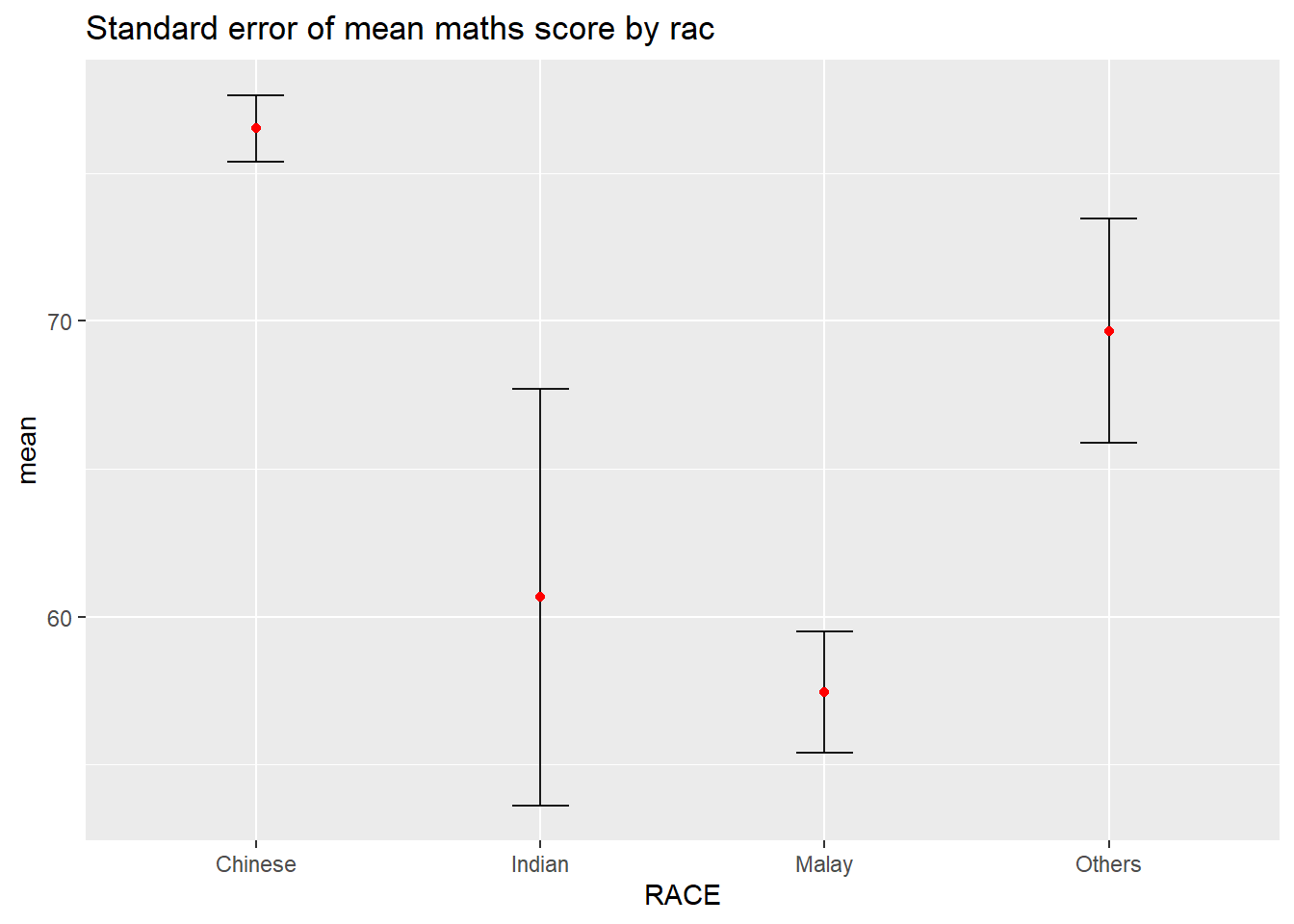
The code chunk belows plots the standard error bars of mean maths score by race.

Note:

  • The error bars are computed by using the formula mean+/-se.

  • For geom_point(), it is important to indicate stat=“identity”.

ggplot(my_sum) +
  geom_errorbar(
    aes(x=RACE, 
        ymin=mean-se, 
        ymax=mean+se), 
    width=0.2, 
    colour="black", 
    alpha=0.9, 
    size=0.5) +
  geom_point(aes
           (x=RACE, 
            y=mean), 
           stat="identity", 
           color="red",
           size = 1.5,
           alpha=1) +
  ggtitle("Standard error of mean maths score by rac")

Plotting confidence interval of point estimates

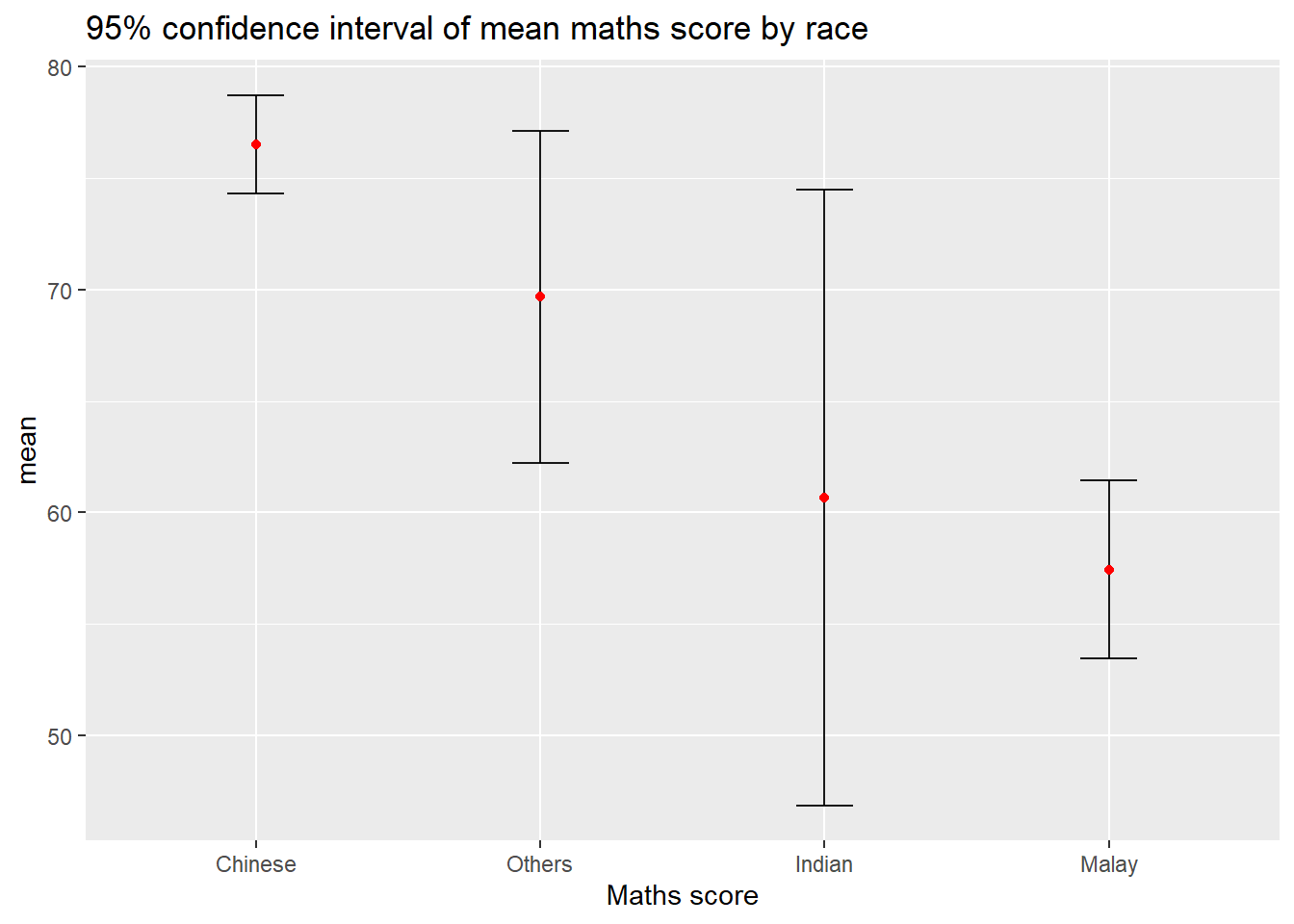
Instead of plotting the standard error bar of point estimates, the confidence intervals of mean maths score by race can also be plotted.

Note:

  • The confidence intervals are computed by using the formula mean+/-1.96*se.

  • The error bars is sorted by using the average maths scores.

  • labs() argument of ggplot2 is used to change the x-axis label.

ggplot(my_sum) +
  geom_errorbar(
    aes(x=reorder(RACE, -mean), 
        ymin=mean-1.96*se, 
        ymax=mean+1.96*se), 
    width=0.2, 
    colour="black", 
    alpha=0.9, 
    size=0.5) +
  geom_point(aes
           (x=RACE, 
            y=mean), 
           stat="identity", 
           color="red",
           size = 1.5,
           alpha=1) +
  labs(x = "Maths score",
       title = "95% confidence interval of mean maths score by race")

Visualizing the uncertainty of point estimates with interactive error bars

The code chunk below plots interactive error bars for the 99% confidence interval of mean maths score by race.

shared_df = SharedData$new(my_sum)

bscols(widths = c(4,8),
       ggplotly((ggplot(shared_df) +
                   geom_errorbar(aes(
                     x=reorder(RACE, -mean),
                     ymin=mean-2.58*se, 
                     ymax=mean+2.58*se), 
                     width=0.2, 
                     colour="black", 
                     alpha=0.9, 
                     size=0.5) +
                   geom_point(aes(
                     x=RACE, 
                     y=mean, 
                     text = paste("Race:", `RACE`, 
                                  "<br>N:", `n`,
                                  "<br>Avg. Scores:", round(mean, digits = 2),
                                  "<br>95% CI:[", 
                                  round((mean-2.58*se), digits = 2), ",",
                                  round((mean+2.58*se), digits = 2),"]")),
                     stat="identity", 
                     color="red", 
                     size = 1.5, 
                     alpha=1) + 
                   xlab("Race") + 
                   ylab("Average Scores") + 
                   theme_minimal() + 
                   theme(axis.text.x = element_text(
                     angle = 45, vjust = 0.5, hjust=1)) +
                   ggtitle("99% Confidence interval of average /<br>maths scores by race")), 
                tooltip = "text"), 
       DT::datatable(shared_df, 
                     rownames = FALSE, 
                     class="compact", 
                     width="100%", 
                     options = list(pageLength = 10,
                                    scrollX=T), 
                     colnames = c("No. of pupils", 
                                  "Avg Scores",
                                  "Std Dev",
                                  "Std Error")) %>%
         formatRound(columns=c('mean', 'sd', 'se'),
                     digits=2))

Visualising Uncertainty: ggdist package

  • ggdist is an R package that provides a flexible set of ggplot2 geoms and stats designed especially for visualising distributions and uncertainty.

  • It is designed for both frequentist and Bayesian uncertainty visualization, taking the view that uncertainty visualization can be unified through the perspective of distribution visualization:

    • for frequentist models, one visualises confidence distributions or bootstrap distributions (see vignette(“freq-uncertainty-vis”));

    • for Bayesian models, one visualises probability distributions (see the tidybayes package, which builds on top of ggdist).

Visualizing the uncertainty of point estimates: ggdist methods

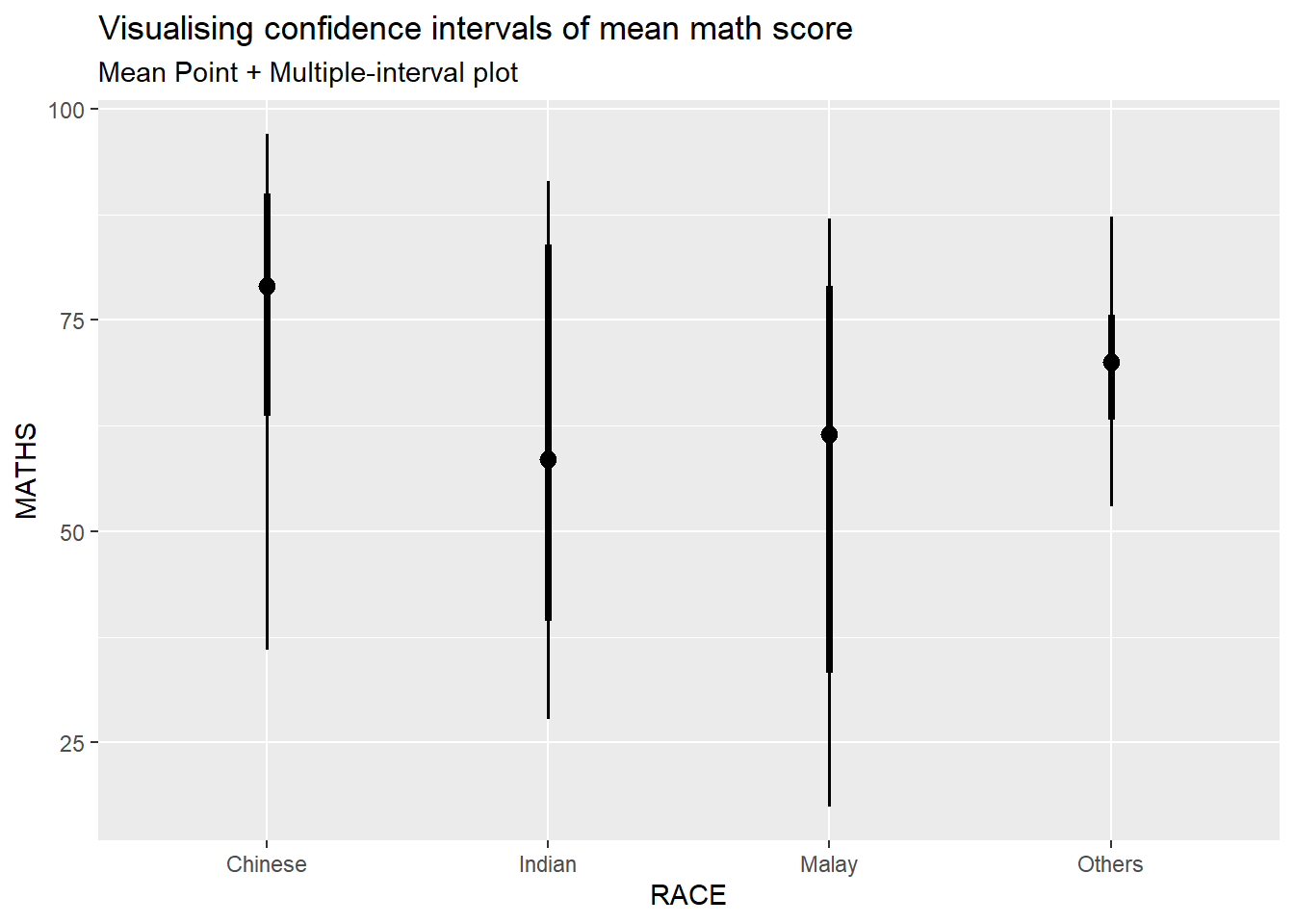
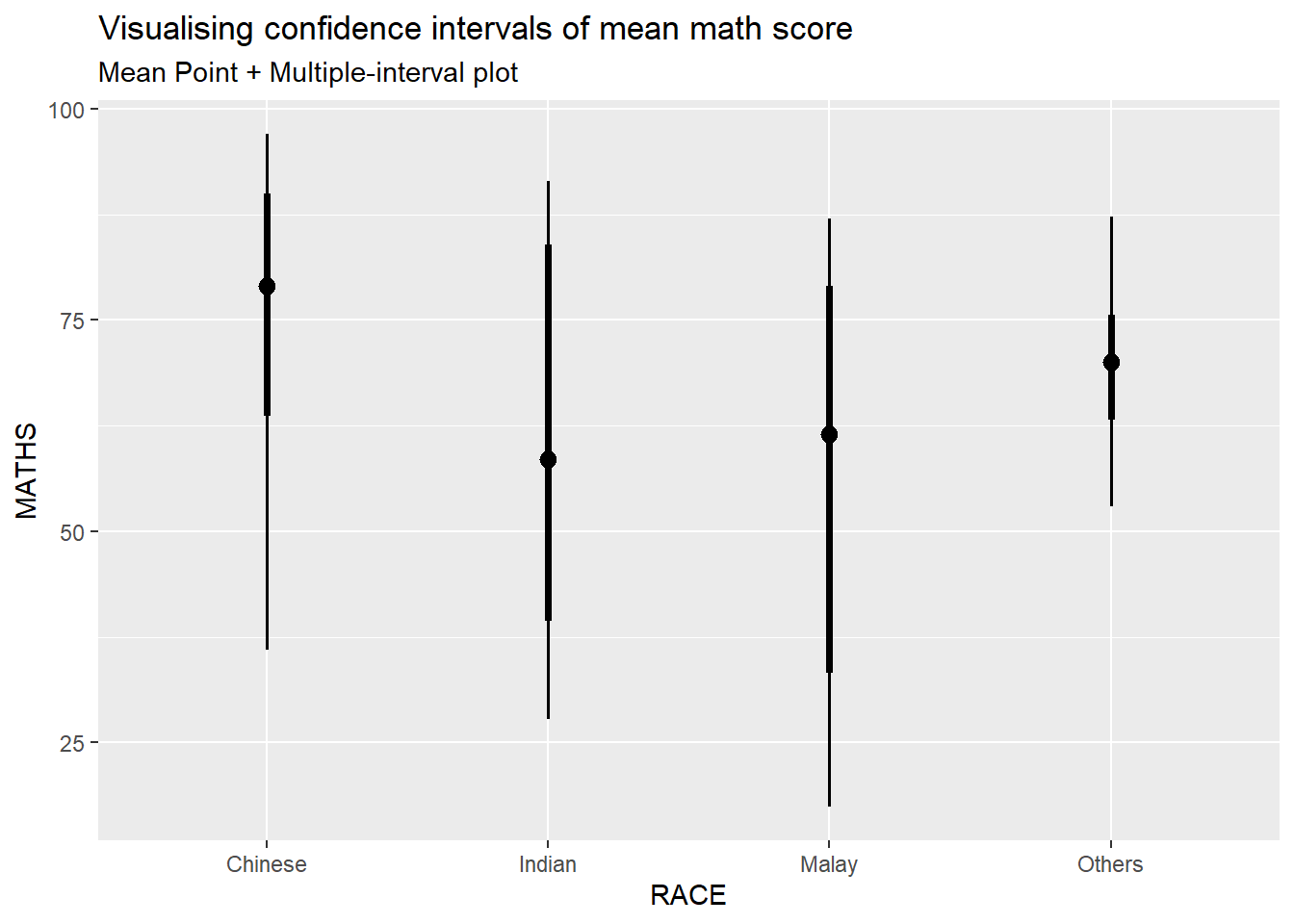
In the code chunk below, stat_pointinterval() of ggdist is used to build a visual for displaying distribution of maths scores by race.

exam %>%
  ggplot(aes(x = RACE, 
             y = MATHS)) +
  stat_pointinterval() +
  labs(
    title = "Visualising confidence intervals of mean math score",
    subtitle = "Mean Point + Multiple-interval plot")

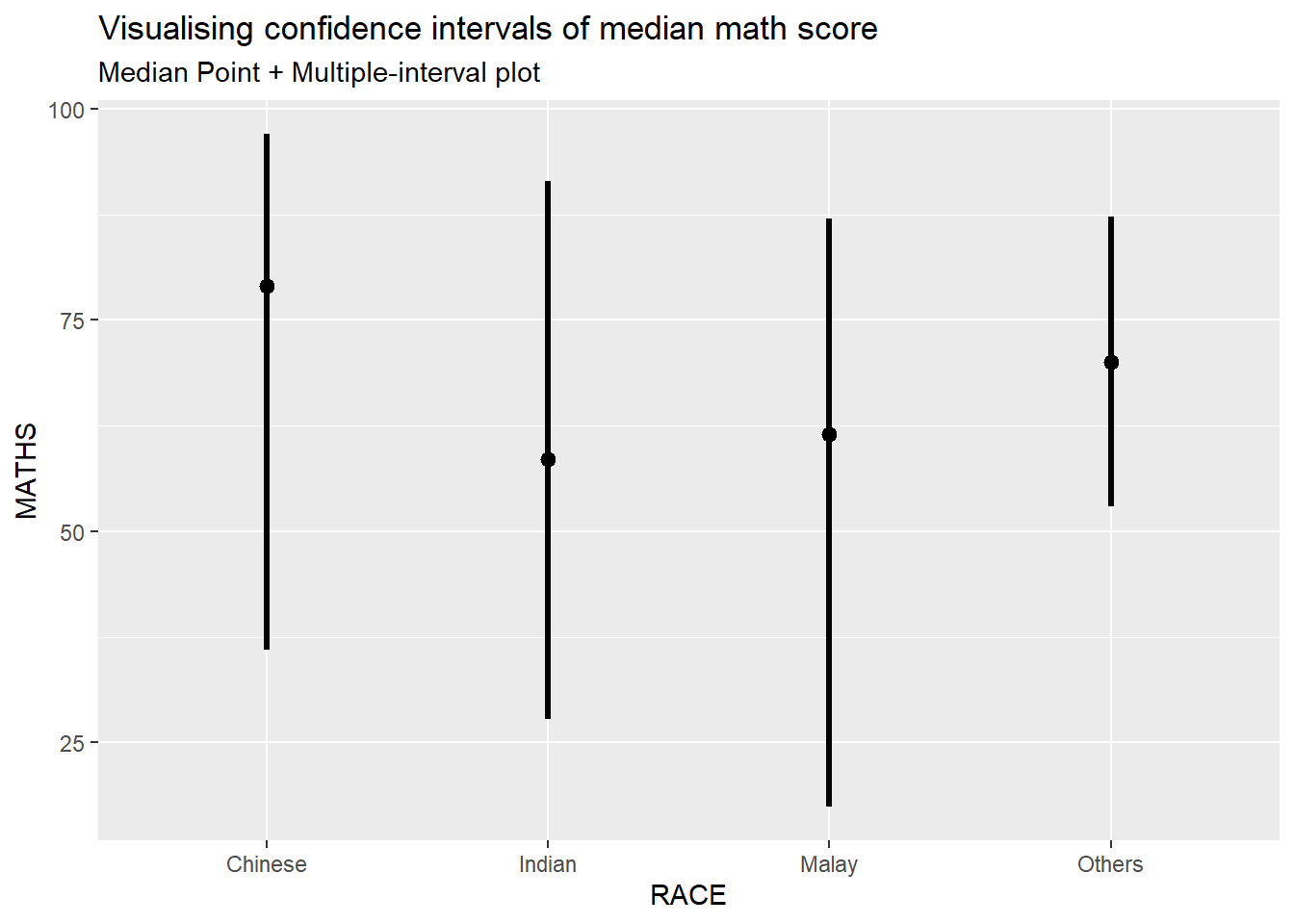
In the code chunk below the following arguments are used:

  • .width = 0.95

  • .point = median

  • .interval = qi

exam %>%
  ggplot(aes(x = RACE, y = MATHS)) +
  stat_pointinterval(.width = 0.95,
  .point = median,
  .interval = qi) +
  labs(
    title = "Visualising confidence intervals of median math score",
    subtitle = "Median Point + Multiple-interval plot")

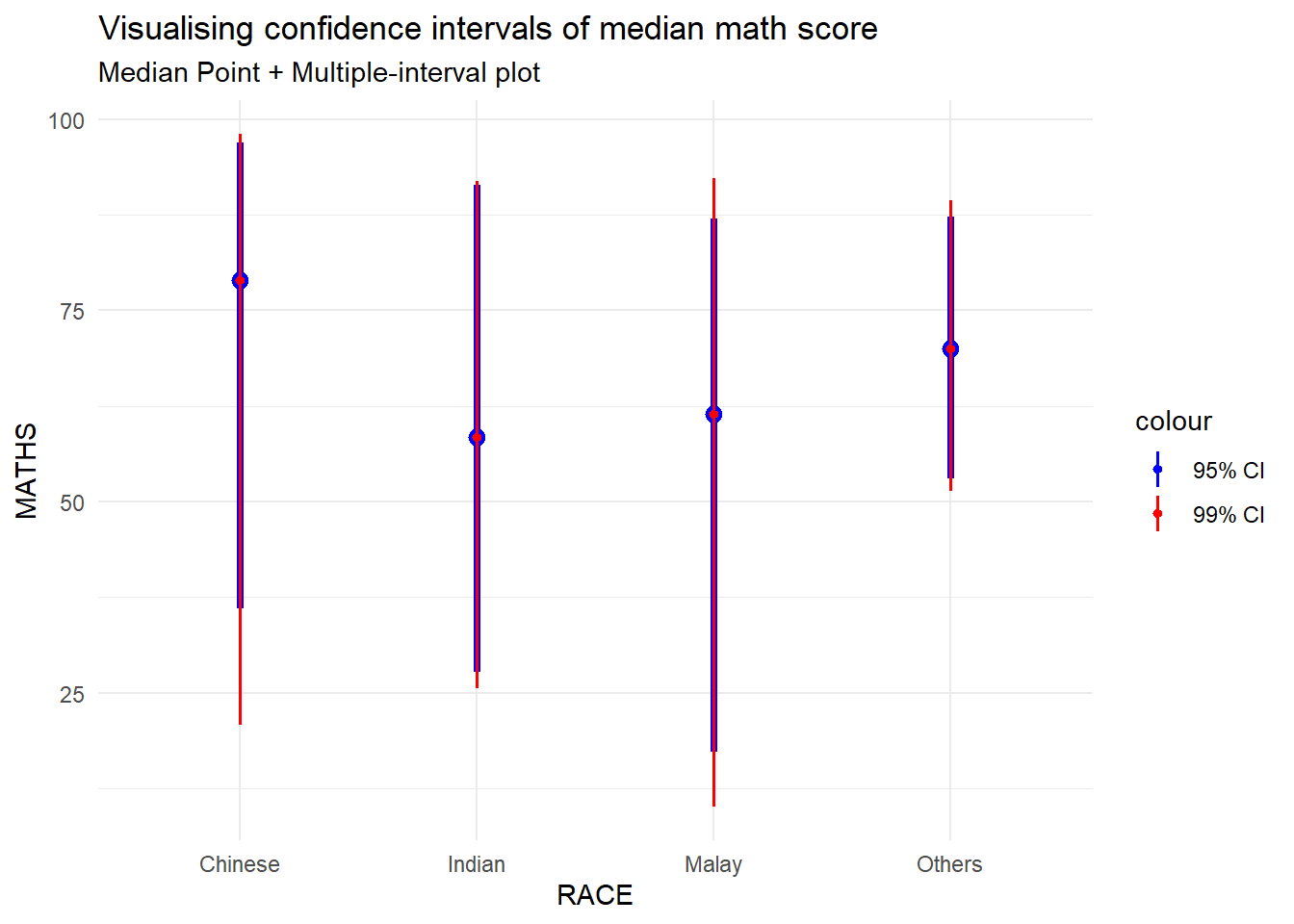
The plot below shows 95% and 99% confidence intervals

  • stat_pointinterval is used twice, once for each confidence interval.

  • The .width argument specifies the width of the intervals.

  • The .point argument specifies that we want to plot the median.

  • The .interval argument is set to “quantile” to indicate quantile-based intervals.

  • scale_colour_manual is used to set custom colors for the confidence intervals and provide custom labels.

  • Other aesthetic adjustments are made to improve the appearance of the plot, such as adjusting the size and position of the intervals.

exam %>%
  ggplot(aes(x = RACE, y = MATHS)) +
  stat_pointinterval(
    .width = 0.95,
    .point = "median",
    .interval = "quantile",
    aes(colour = "95% CI")) +
  stat_pointinterval(
    .width = 0.99,
    .point = "median",
    .interval = "quantile",
    aes(colour = "99% CI")) +
  scale_colour_manual(
    values = c("95% CI" = "blue", "99% CI" = "red"),
    labels = c("95% CI", "99% CI")) +
  labs(
    title = "Visualising confidence intervals of median math score",
    subtitle = "Median Point + Multiple-interval plot") +
  theme_minimal()

Visualizing the uncertainty of point estimates: ggdist methods

exam %>%
  ggplot(aes(x = RACE, 
             y = MATHS)) +
  stat_pointinterval(
    show.legend = FALSE) +   
  labs(
    title = "Visualising confidence intervals of mean math score",
    subtitle = "Mean Point + Multiple-interval plot")

Visualising the uncertainty of point estimates: ggdist methods

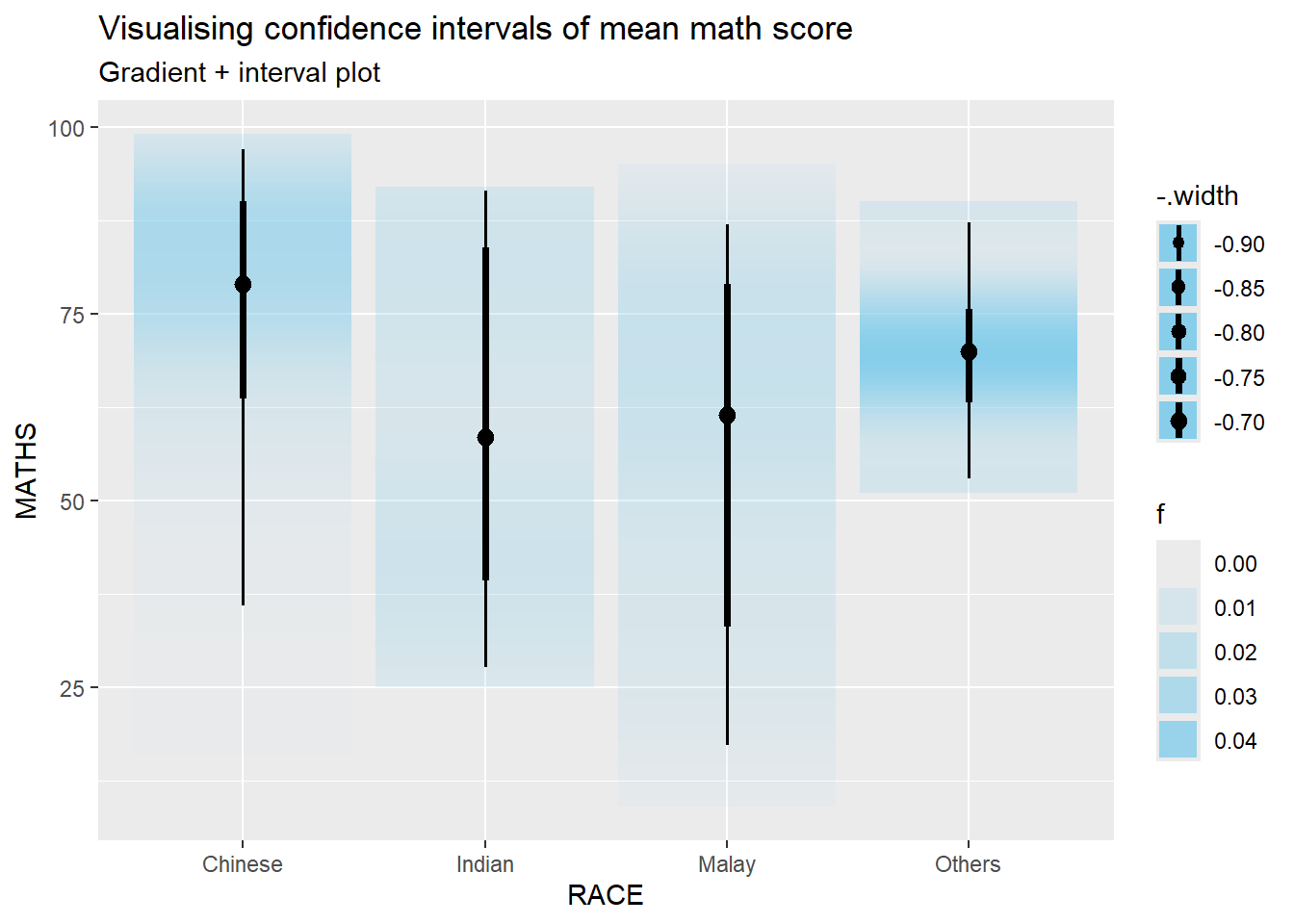
In the code chunk below, stat_gradientinterval() of ggdist is used to build a visual for displaying distribution of maths scores by race.

exam %>%
  ggplot(aes(x = RACE, 
             y = MATHS)) +
  stat_gradientinterval(   
    fill = "skyblue",      
    show.legend = TRUE     
  ) +                        
  labs(
    title = "Visualising confidence intervals of mean math score",
    subtitle = "Gradient + interval plot")

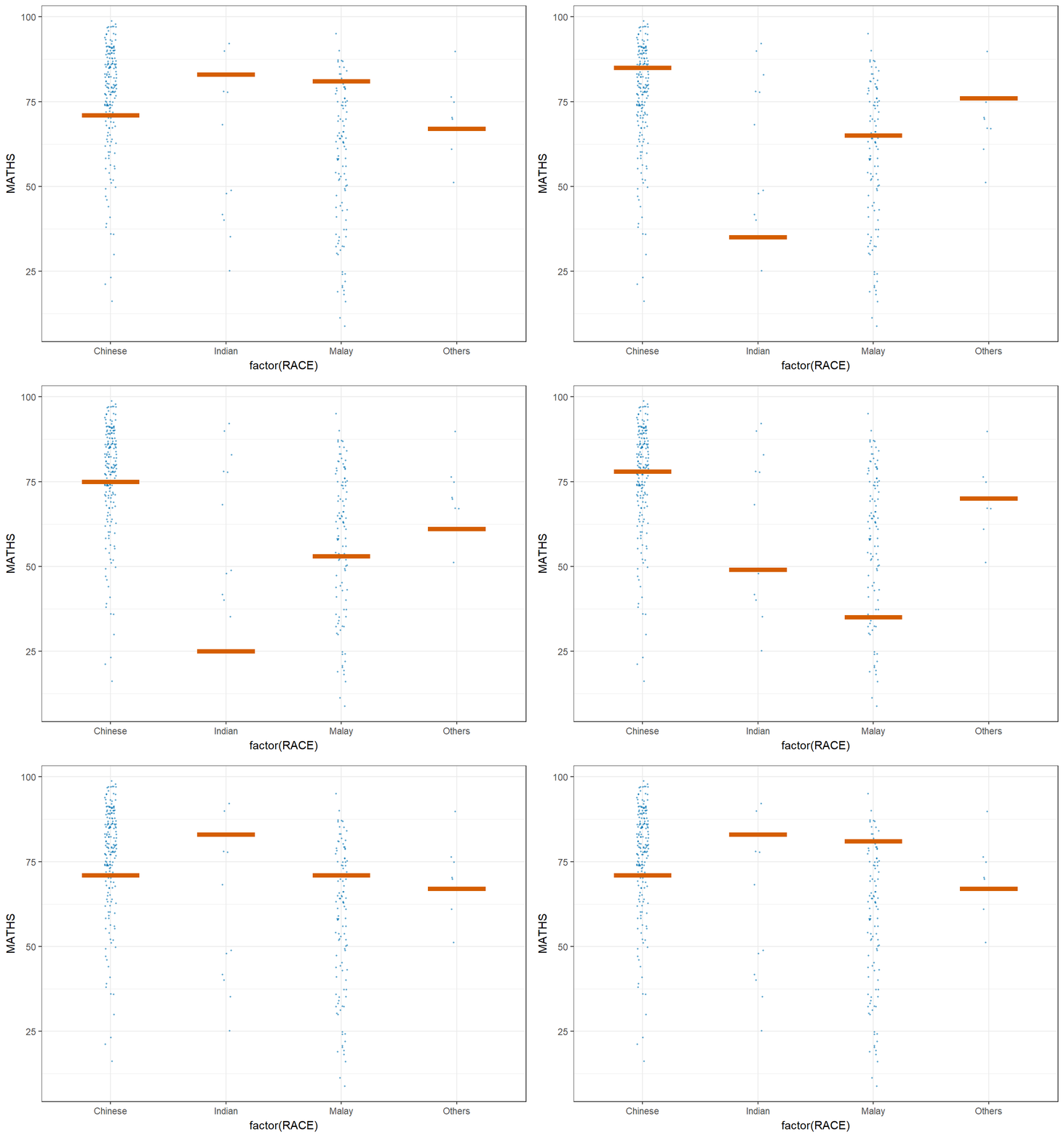
Visualising Uncertainty with Hypothetical Outcome Plots (HOPs)

ggplot(data = exam, 
       (aes(x = factor(RACE), y = MATHS))) +
  geom_point(position = position_jitter(
    height = 0.3, width = 0.05), 
    size = 0.4, color = "#0072B2", alpha = 1/2) +
  geom_hpline(data = sampler(25, group = RACE), height = 0.6, color = "#D55E00") +
  theme_bw() + 
  # `.draw` is a generated column indicating the sample draw
  transition_states(.draw, 1, 3)

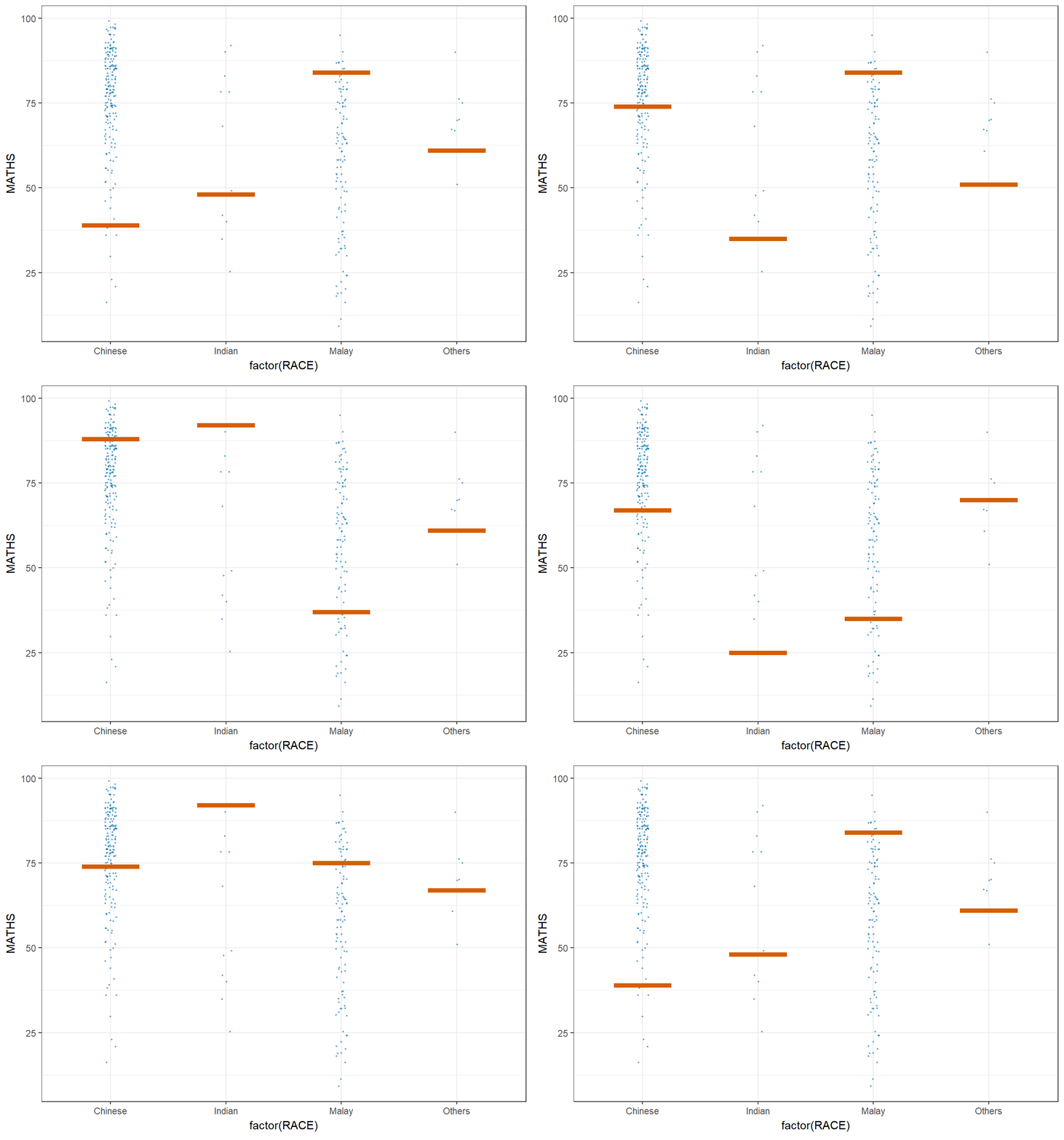
Visualising Uncertainty with Hypothetical Outcome Plots (HOPs)

ggplot(data = exam, 
       (aes(x = factor(RACE), 
            y = MATHS))) +
  geom_point(position = position_jitter(
    height = 0.3, 
    width = 0.05), 
    size = 0.4, 
    color = "#0072B2", 
    alpha = 1/2) +
  geom_hpline(data = sampler(25, 
                             group = RACE), 
              height = 0.6, 
              color = "#D55E00") +
  theme_bw() + 
  transition_states(.draw, 1, 3)